
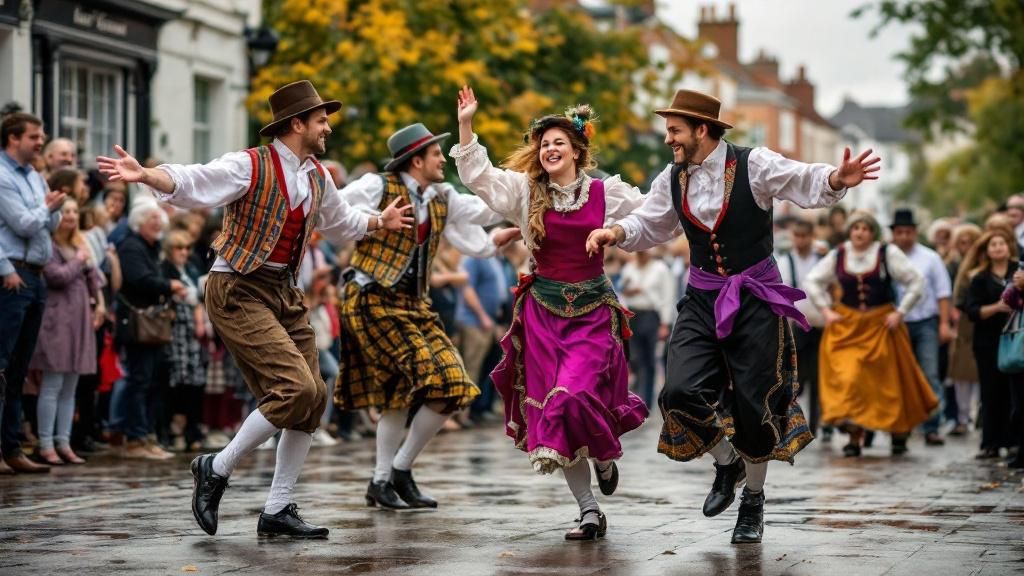
Once cast aside as a quaint relic of England’s countryside traditions, Morris dancing is undergoing an unexpected revival amongst Britain’s youth. From university societies to rural commons, devotees aged under thirty are rediscovering the patterned movements, bell-adorned accessories, and bright garments that have defined this ancient custom. This article investigates the factors driving this cultural resurgence, considers how contemporary performers are reinterpreting the style, and considers what this renewed interest reveals about current British views towards tradition and social connection.
The Cultural Renaissance of Morris Dance
The resurgence of Morris dancing amongst young people across Britain demonstrates a striking shift from years of falling participation. What was once considered an purely rural or older pursuit has transformed into a vibrant cultural phenomenon, with student societies, city-based dance ensembles, and community organisations enthusiastically adopting the tradition. This resurgence disrupts long-held stereotypes and demonstrates that modern youth find genuine value in maintaining and honouring Britain’s traditional heritage, revitalising practices that appeared headed toward obscurity.
This fresh energy transcends basic heritage nostalgia; young performers are actively reshaping Morris dancing for contemporary times. They incorporate contemporary music, try out inventive dance routines, and build open-minded collectives that accept people regardless of social background or dance experience. The trend demonstrates a wider cultural change wherein young British people deliberately look for authentic connections to their ancestral traditions whilst at the same time reshaping tradition’s significance, creating a dynamic dialogue between heritage fidelity and modern artistic interpretation that connects with what matters to their age group.
Why Young Adults Are Embracing This Time-Honoured Craft
Morris dancing’s attraction for younger generations goes well past nostalgic curiosity. Contemporary dancers value the art form’s substantial cultural legacy whilst acknowledging its ability to enable creative expression and social connection. The ease of access to modern Morris groups, paired with their welcoming approach, has transformed the understanding of this traditionally insular pursuit. Young people are discovering that Morris dancing delivers a worthwhile substitute to standard recreational pursuits, providing both physical challenge and authentic social connection in an ever more digital world.
Community Connection
In an time marked by social fragmentation, Morris dancing groups offer young people with concrete social networks founded on common principles and joint participation. The welcoming character of contemporary Morris organisations actively welcomes newcomers irrespective of background or experience, fostering authentic bonds and meaningful connections. Participants frequently characterise their dancing cohorts as chosen families, providing emotional support and a sense of place that stretches well beyond the performance season. This sense of community becomes particularly valuable for young people navigating university or early career transitions.
The collaborative framework of Morris dancing inherently fosters group unity and reciprocal obligation. Each dancer’s participation directly affects the group’s aesthetic coordination and temporal accuracy, creating interconnectedness that strengthens interpersonal connections. Many young dancers note that their Morris groups enable real friendships in ways that conventional social settings often fail to deliver. The shared commitment to preserving and evolving this cultural heritage creates a strong feeling of shared mission amongst participants.
Physical Activity and Wellbeing
Morris dancing demands considerable physical exertion, combining cardiovascular exercise with complex coordination and strength development. Young dancers benefit from enhanced physical capability whilst participating in activity that carries cultural significance rather than simply functional. The rhythmic, repetitive nature of Morris footwork offers contemplative benefits alongside physical conditioning, enhancing mental wellbeing. Participants commonly mention the holistic health benefits as a main reason for continued participation in their local Morris groups.
Beyond heart health advantages, Morris dancing cultivates proprioceptive awareness and bodily confidence, particularly valuable for adolescents struggling with body image concerns. The emphasis on technical precision and synchronized movement redirects focus from appearance-based concern towards capability and achievement. Moreover, the open-air staging culture connected to Morris dancing prompts people to interact with natural environments and seasonal rhythms, supporting mental health through engagement with nature and tradition.
Regional Variations and Contemporary Modifications
Morris dancing practices differ considerably across Britain’s regions, with each region developing characteristic forms capturing regional history and landscape. The Cotswolds uphold the vigorous, athletic “Cotswold” approach, whilst the North West favours the increasingly ornate “Northwest” style showcasing ornate attire and intricate formations. Younger dancers are enthusiastically embracing these area-specific traditions, participating in training and celebrations to perfect authentic techniques whilst understanding the subtle cultural elements woven throughout each style. This geographical diversity gives contemporary performers with diverse opportunities into Morris dancing, helping them engage with traditions grounded in their own communities.
Modern adaptations are concurrently broadening Morris dancing’s appeal outside traditional contexts. Younger practitioners incorporate contemporary music, experimental choreography, and inclusive casting practices, challenging historical gender and age restrictions. Mixed-gender sides and LGBTQ+ Morris groups have developed, fundamentally transforming the tradition’s social dynamics. These innovations preserve the essential character—rhythmic footwork, bells, and festive energy—whilst rendering the practice more approachable and relevant to contemporary participants. Such creative reinterpretation demonstrates that heritage traditions needn’t remain static, successfully bridging historical authenticity with modern sensibilities.
The Evolution of Morris Dance in the United Kingdom
As Morris dancing keeps engaging younger audiences, the tradition stands at a critical crossroads. Contemporary dancers are actively reshaping the form whilst maintaining its cultural heritage, bringing new dance moves and welcoming approaches that align with modern sensibilities. Universities document unprecedented enrolment in Morris societies, whilst festivals welcome exceptional participation of young participants. This momentum suggests the art form is transitioning from nostalgic curiosity to genuine cultural movement, creating enduring frameworks for long-term growth and continued relevance within British communities nationwide.
Looking ahead, Morris dancing’s trajectory appears remarkably promising. The convergence of social media promotion, straightforward instruction approaches, and younger generations’ appetite for authentic community connection creates ideal conditions for flourishing. Organisations are investing in apprenticeship schemes and local contests, fostering talent pipelines and ensuring knowledge transfer between veteran and newer performers. Should this enthusiasm persist, Morris dancing may finally move beyond its image as exclusively historically-oriented, instead becoming recognised as a dynamic, developing art form that genuinely improves contemporary British society and deepens social connections across generations.
